 In the Schenck vs U.S. verdict, Schenck was found guilty by the Supreme Court on three accounts: exercising conspiratorial actions, conspiring to commit a crime against the U.S., and unrightfully using the postal system to send "unmailable" items. A secretary to the Socialist party during WWI, Schenck was arrested and put on trial for distributing "anti-war" pamphlets that caused unease and defiance amongst troops drafted into the Great War. Falling back on the Constitution's 1st Amendment, Schenck argued that the governmental laws (Conscription Act and the Selective Service Act) were unconstitutional since they violated the 13th Amendment -- forbid the practice of undesired labor. Furthermore, Schenck indicated that people had the right to protest acts such as these. When put on trial, Schenck stubbornly claimed that his right to freedom of the press was created and established by the 1st Amendment of the Constitution. Despite this, however, the Supreme Court felt that this right was not consistent with the manner in which the crime was committed as his rights to free speech caused a "clear and present danger" to the safety of those around him. His actions were synonymous with shouting fire in a theatre -- it would cause widespread chaos and obstruct the serenity of his surroundings.
Monday, February 13, 2012
LAD #30: Schenck vs. United States
In the Schenck vs U.S. verdict, Schenck was found guilty by the Supreme Court on three accounts: exercising conspiratorial actions, conspiring to commit a crime against the U.S., and unrightfully using the postal system to send "unmailable" items. A secretary to the Socialist party during WWI, Schenck was arrested and put on trial for distributing "anti-war" pamphlets that caused unease and defiance amongst troops drafted into the Great War. Falling back on the Constitution's 1st Amendment, Schenck argued that the governmental laws (Conscription Act and the Selective Service Act) were unconstitutional since they violated the 13th Amendment -- forbid the practice of undesired labor. Furthermore, Schenck indicated that people had the right to protest acts such as these. When put on trial, Schenck stubbornly claimed that his right to freedom of the press was created and established by the 1st Amendment of the Constitution. Despite this, however, the Supreme Court felt that this right was not consistent with the manner in which the crime was committed as his rights to free speech caused a "clear and present danger" to the safety of those around him. His actions were synonymous with shouting fire in a theatre -- it would cause widespread chaos and obstruct the serenity of his surroundings.
Saturday, February 4, 2012
LAD #29: Keating Owen Child Labor Act
 The Keating Owen Act was created to prevent interstate trade of child made products. In general, the founded preventions created the fact that for any product made via participation of labor from anyone under sixteen -- not that interstate trade could be conducted with the product (prevent the constitutional regulations). Furthermore, the act outlawed the usage of child labor for more than eight hours per day, six days a week, earlier than six am, or later than seven pm. Plus, it was provided the act was the right of the Attorney General, Secretary of Labor, and the Secretary of Commerce to construct a board to create and publish uniform rules to enforce provisions. The Secretary of Labor has additional power to inspect and extrapolate any mill, workshops, etc. to ensure that the above regulations are followed. Any violations whatsoever discovered by anybody would be immediately brought to district courts "sine mora" (without delay). Yet this does not apply to any organized clubs recognized by the Agricultural Department of the United States (punishments = maximum of $200 for the first offense and a maximum of $1000/ imprisonment for 3 months. With any false statements made by the guarantee of a person claiming the production of a product follows that the stipulations above is applied to said person.
LAD #28: Wilson's First Inaugural
 From the very start of his first inaugural, Wilson advocates that change has occurred. The Government has taken a turn to become predominately democratic. However, this doesn't mean that an extreme shift of ideals will accompany the shift of political affiliation. Better yet, a new order has come to appropriate the aspect of things that have grown to become known and familiar. Numerous troubles were threatening the teetering nation then (mostly involving conflicts against the Progressive Platform that Teddy Roosevelt and Taft efficiently obliged to. Therefore, Wilson goes on to praise the moral and mental strength of the American nation -- before the list of problems he demands must be addressed (among them: conserving natural resources). Hence, a mentality was created by every human or generation themselves, a biased and uncontrollable mentality. On the contrary, Wilson claims that justice should be the overall goal of the government. First it must rectify the countless wrongs of industrialization (tariffs and corruptness), respect towards the rights of labor, and agricultural gratification. From Wilson's perspective, the government has become an instrument to ensure the equality of society. Yet, even doing this, Wilson still remains at ease and thoughtful with his asking for the aid of humanity -- to modify the economic domination one step at a time.
LAD #27: Clayton Antitrust Act
 The Clayton Anti-Trust Act, simply, serves to legitimize and open up America's stand against the corruptness of Big Business and the Robber Barons of those corporations. It was a figurehead that stood on the shoulders of the Sherman Anti-Trust Act created prior. One regulation created by the act was that it made the discrimination of price between numerous products of similar value obsolete -- example: charging more for short railroad trips than long railroad trips -- if this undermines competition and raises the chance of corporate monopoly. Yet, this document was not created to prevent the consumers choice and bona fide transactions (allowing complete an utter free trade). Another benefit of the act was to prohibit granting unjust rebates and other price shifting properties used to force out competition. Lastly, an additional prevention heeds the causation of free trade by preventing intercompany stock purchasing in order to lessen competition
Tuesday, January 17, 2012
LAD #26: MLK I Have A Dream Speech
 In honor of Martin Luther King Jr., we see fit to listen to his famous words during his "I have a dream" speech on the day named after his work for civil equality. Addressing the masses who attended his speech in front of the Lincoln Memorial, King speaks of the signing of the Emancipation Proclamation that had ensured the freedom of the black slaves from the perils of social status under the white supremacy. He goes on to declare that even though the laws laid forth by the famed president in media res of the Civil War, the "Negro is not free," and has become an exile in his own land. King (and all those whom followed him) therefore have come together at the nation's capitol to "cash their check." A check promising the protection of ALL men, unalienable rights - life liberty and the pursuit of happiness - to ALL men; no more segregation. King hopes that one day justice will come and denies all doubt of impossible equality; he has faith in the American people. Yet, King also makes clear that violence is never the answer. Instead, he orates that people must affirm their beliefs of justice with patience, not hatred. In order to progress in the rights movement, the rights of white men must first be upheld before they can fully seek gratitude and equality. King then goes on to explaining his idealistic vision of the future: dreaming of the day when the sons of formers slaves and slave owners can congregate without feud; a day when little black and white boys and girls can hold hands as sisters and brothers. In order for this to be a reality people must dedicate themselves to liberty and freedom, giving the phrase the deserved awe and respect it demands: "let freedom ring." For it must ring from all throughout the United States, in both the lands free of hatred and the sweltering hot spots of racial contention in the South, from ever "hill and molehill of Mississippi." When that becomes a reality, then the people of the nation may move forward together as prophesied in King's noble dreams.
Saturday, January 7, 2012
LAD#25: The Dawes Act
 Approved on February, 1887, the Dawes Act was created to continue the US's policy of abiding by the rules of Indian reservations. To implement this goal, government created a set of steps that would section out tracks of land for ownership to the Indian families -- even though the US still owned it. To populate these reserves more cooperatively (no force), the Dawes Act claims that land will be siphoned out as such: 1/4 to each head of family, 1/8 for any person over 18 or any orphan under 18, and 1/16 to any person under 18 born prior to the rules of allocation. Additionally, there are much more beneficial factors to the Dawes Act dealing with land allocation (grazing land for animals). Furthermore, to prevent conflict between tribes, provisional lines would be made to assure that every one's land is completely equal to what they are entitled. Yet, if suitable lines are not drawn by the landholders themselves, an agent of the tribe IS allowed to draw a fair boundary line as directed by the Secretary of the Interior. Also, covering the issue of non-reservation Indians, they can still be given land as long as they apply to the local land office. Patents can be handed out to ensure that the Indian lands are owned for 25 years. Extensions, selling, or purchasing lands will be regulated by the Secretary of the Interior. The US also has the right to use sold Indian land for the distribution of settled homes, education, etc.. Any religious organizations will be given 160 acres automatically. Finally, citizenship is offered to any Indians who follow this act as no law can be to deny the Indians' personal protection without processing that any Indian born in US territory has been given land shall become a US citizen. Yet, this act does not apply to all such as the many displaces nations due to the Trail of Tears as well as those being from the Seneca Nation of NY. Also, this act holds no protection of Indian lands from being cut through by railroads, telegraph lines, or public uses as decreed by Congress.
Thursday, January 5, 2012
LAD #24: Cross of Gold Speech
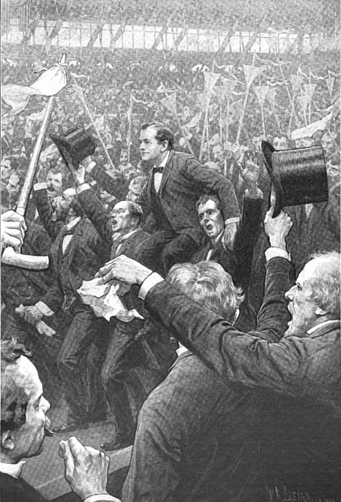 William Jennings Bryan was able to successfully integrate the values of the Populist Party in his "Cross of Gold" speech to the Democratic Convention in Chicago in 1896. Most notably concerning the platform of bimetallism (both gold and silver should be coined by the U.S. mint), Bryan begins by saying that the money question is the issue of the hour -- asserting that silver Democrats are not here to deliberate their stand on this issue. He wished to clarify that there was no plan of hostility of the Democrats against the Republicans (even though it drastically conflicts the ideas of the Republican platform). He then defends his platform against Republican accusations -- the first of which say that bimetallism would interfere with their big business -- responding that the Republican practices have interfered with the "common man's" business. Further Republican accusations involve the Democrats passing an alleged "unconstitutional" graduated income tax law -- Bryan merely holds that he is indeed supported of such a cause (it accurately represents the Democratic ideals upon which the nation was founded - that every man must contribute his own share in order to fully deserve to enjoy their protection). Republicans also condemned the Democrats' opposition to the national bank's currency (which Bryan accepts) comparing their stand to that of Andrew Jackson's against the conspiracy that was the BUS. He also compares himself to Jefferson (he thinks that money is a function of the government, not up to the banks to be printed/ distributed). Bryan then looks at the inconsistencies of the Republican party, saying that the platform on which McKinley was elected called for a gold standard until bimetallism was achieved... if the gold standard is as beneficial as the Republicans claim, why are they waiting to replace it? Bryan thus successfully orates his position on the gold standard, combining the Populist and Democratic Parties.
Subscribe to:
Posts (Atom)